The days between appointments are the ones you forget.
Adnotia is a notebook for ADHD. You write down how a day went, in about a minute. It keeps those days, and turns a fortnight of them into one page you can hand to whoever you are seeing.
Nothing leaves your phone. There is no server to send it to.
No account, no email, no sign-up. Open it and start.
Free, and open source. You can read every line of it.
What it does
Everything you turned on, and nothing else
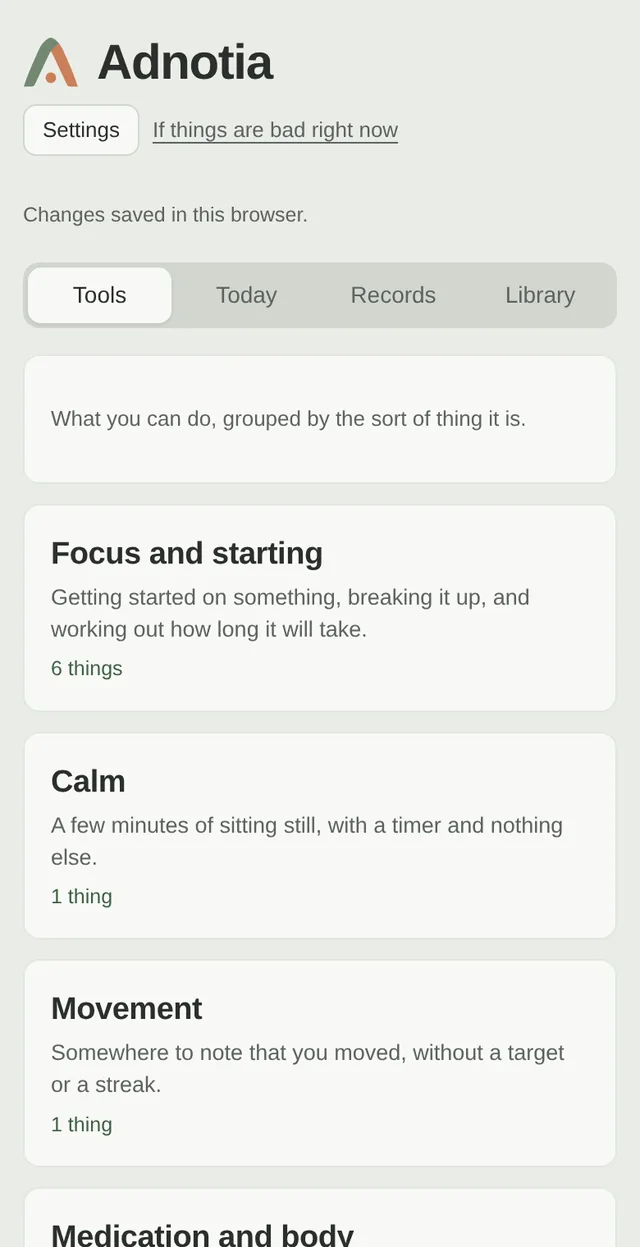
You pick what you want help with. The app is built from that: areas you can look through, and tools inside them. If you do not take medication you will never see a dose field, and if you do, it is one tool among several rather than the whole app.
A minute at the end of the day
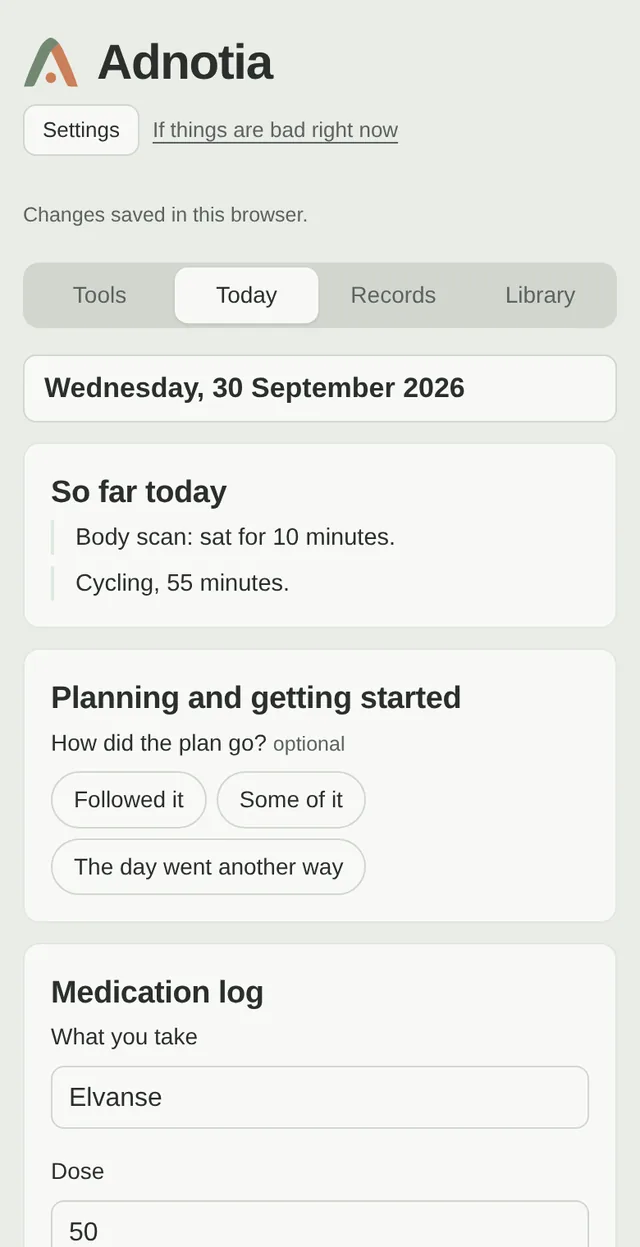
A few questions, put together from the tools you use, and a list of what already happened — the timer you ran, the walk you took — so the day's record is the whole day and not only the parts that were questions.
Miss a day and it says a day is missing. That is all it says.
One page to take with you
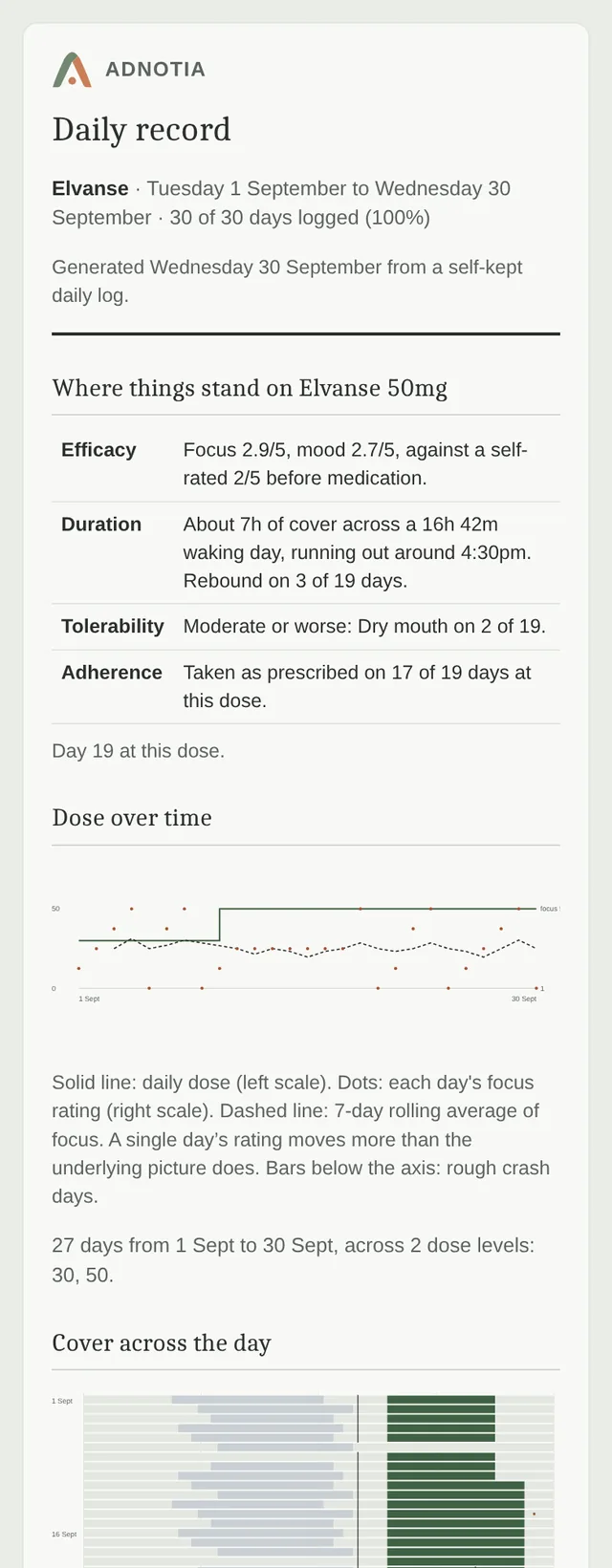
A fortnight of days becomes a single sheet: what you took, what you noticed, how the days went, and how much of the record is actually there. It says how many days you logged out of how many, and which ones you filled in later.
You read it before anybody else does. There is nothing in it you have not seen.
What it will not do
- It will not tell you whether you have ADHD. That is a clinician's job, over time.
- It will not recommend a dose, or tell you whether to take one today.
- It will not score you, rank you, or judge how honest you are being.
- It has no streaks, no badges and no points. Nothing here is trying to keep you.
- It will not send your record anywhere, in any form, ever.
- It cannot protect what it keeps from a browser extension that is allowed to read the pages you visit — and no site can even tell you which extensions you have. It offers a passcode at the start, and there is a version you run from a file on your own computer.
Each of those is written into the project's scope document rather than into a promise, and the source is public so you can check.
Why it exists
The appointment is twenty minutes and it is months away. What happens in it depends on days you will have stopped being able to remember by then — which is how people end up on too much and on too little, both from the same sentence, which is it has been alright, I think.
So this is a notebook. It is not trying to be clever about your data, and it is not trying to be your friend. You write down how a day went, it keeps the days, and when you need them it lays them out in a way somebody clinical can read in a minute.
It is free because there is nothing to charge for: no server, no account, no one being paid to make you open it. And it says how good the evidence for each tool is, in plain words, including where that evidence is thin — because most apps in this area do not, and you cannot tell which half of one you are using.
If you are reading this at one in the morning, the app was written for that too.
For parents, too
A separate space for a child you care for: a dated log of what you have actually noticed, at home and at school, and the parenting tools with the best evidence behind them — routines, a first-and-then board, and a star chart you run yourself. There is a small screen you can hand over, with a timer and today's plan on it and no way back out without your code.